Casino Imagery from Hogarth’s Prints to Film
Casino imagery in mass media shifts from social display to satire and suspense; compare identifiable works to see how cards and gaming rooms change meaning.
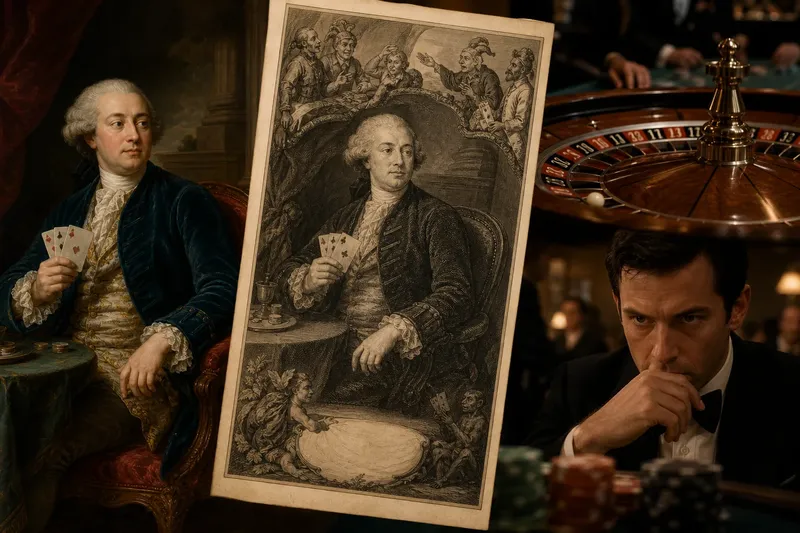
Casino imagery in mass media changes meaning with its medium: a gaming room can signal moral decline in a satirical print, social standing in a portrait, or suspense in a film. The symbols may recur, but their place in the composition and the context around them decide what they say.
Hogarth turned a gaming room into satire
William Hogarth’s A Rake’s Progress follows Tom Rakewell through a sequence of social and personal decline. Its final plate places him in Bedlam, not at a gaming table. The series uses earlier scenes of spending and dissipation to build its moral argument, so identifying a particular plate as a gambling scene requires care.
Hogarth’s crowded compositions ask viewers to read gestures, surroundings, and objects together. In a gaming scene, cards or a table may contribute to a wider account of reckless conduct; they do not, by themselves, establish the scene’s precise location or the whole story behind it.
Check the plate and its caption before naming the venue.
Portraits used cards to present social identity
A portrait could place a sitter among signs of fashionable company, leisure, or money without making play its subject. A card held in the hand or a table near the edge might support a performance of status rather than document a particular game.
Costume, posture, furnishings, and the arrangement of other figures shape how those objects function. Begin with the sitter and setting, then ask what the cards add.
Captions could redirect a printed gaming scene
Engravings and other printed images circulated beyond the rooms or collections associated with their originals. Captions, satire, and new contexts could change how viewers understood a recognizable scene.
A table might suggest refinement, temptation, frivolity, or danger. Gestures, neighboring figures, and accompanying words steer the interpretation; the objects do not carry a fixed moral meaning.
Read the caption before deciding what the image claims about play.
Newspapers made gaming rooms public subjects
Illustrated newspapers and periodicals presented gaming rooms to readers who had never visited one. Editors and illustrators could make a setting legible through a few cues: a table, a wheel, or a player’s concentrated pose.
The same shorthand could accompany discussion of tourism, social standing, respectability, or regulation. An illustration separated from its original article is not self-explanatory, even when its objects seem familiar.
Read the neighboring article before treating an illustration as a record of how a room functioned.
Film made familiar objects suspenseful
Film can move from a room’s entrance to a table, linger on a hand, then cut to a player’s face. Editing gives viewers time to anticipate an outcome, even when they do not know the rules.
Sound adds another layer: a shuffle, a call, or a crowd’s response can suggest a room that a still image only implies. Resemblance between a film and an earlier print does not establish direct influence.
Separate what the camera shows from what the sequence asks viewers to expect.
How can casino imagery be compared?
Did casino imagery begin with one particular painting?
No single painting accounts for gaming images across different media. Name particular works and explain their context rather than proposing one origin for every depiction of play.
Why do cards and roulette wheels recur?
They are recognizable objects that can suggest a gaming setting without showing every detail of a room. Their role depends on composition: they may serve as decoration, a social cue, or the focus of dramatic attention.
Do casino images show what gaming rooms were really like?
They show selected views shaped by a portrait’s, print’s, article’s, or film’s purpose. Treat them as evidence of visual choices and cultural ideas, not complete records of ordinary activity.
How can a recurring convention be distinguished from historical change?
Compare the medium, audience, and purpose, then note which details remain and which change. A card or table may recur while shifting from a sign of social display to a comic prop or dramatic focus.
A close comparison separates repetition from change
Choose images identifiable by medium and setting. For each, record the visible gaming object, its place in the composition, and any caption or surrounding text.
- Portrait: Check whether cards or a table sit at the center or edge. If they are incidental, treat gaming as a supporting social cue; if the sitter’s pose directs attention to them, examine their role in the portrait’s presentation.
- Printed reproduction: Check for a caption that changes the tone. If it adds a joke or warning, include that framing; if no caption survives, avoid assigning a specific moral without other evidence.
- Newspaper illustration: Check the adjacent article. If it concerns a public issue, describe how the image relates to it; if the connection is unclear, report what is visible without guessing at editorial intent.
- Film scene: Check whether editing or sound draws attention to the table. If a hand or reaction receives emphasis, note how the sequence builds anticipation; if not, focus on the room’s broader arrangement.
- Entertainment image: Check whether cards or a wheel appear with little detail about the room. If so, describe them as compressed shorthand; if the setting is fully depicted, compare how its details shape the scene.
- Side-by-side comparison: Check whether the same object serves different purposes. If its role changes, explain the contextual difference; if it appears similar, call it a recurring convention rather than evidence of direct influence.
Say you have three invented images: a portrait of a sitter holding cards beside a small table, a printed copy of that portrait with a satirical caption, and a film scene that pauses on a roulette wheel before cutting to a player’s face. First, record the cards and table as part of the portrait’s presentation, not proof that gaming dominates it. Next, read the caption as the print’s comic framing, then describe the film’s pause and cut as devices that build suspense. The comparison shows that familiar objects can serve different purposes; it does not establish that the film copied either earlier image.
Casino imagery in mass media is clearest when each work is read through its medium and purpose. A shared card, table, or wheel invites comparison, but only contextual evidence can support a claim about influence.